CVPR 2026 Highlight
ResiHMR: Residual-Limb Aware Single-Image 3D Human Mesh Recovery for Individuals with Limb Loss
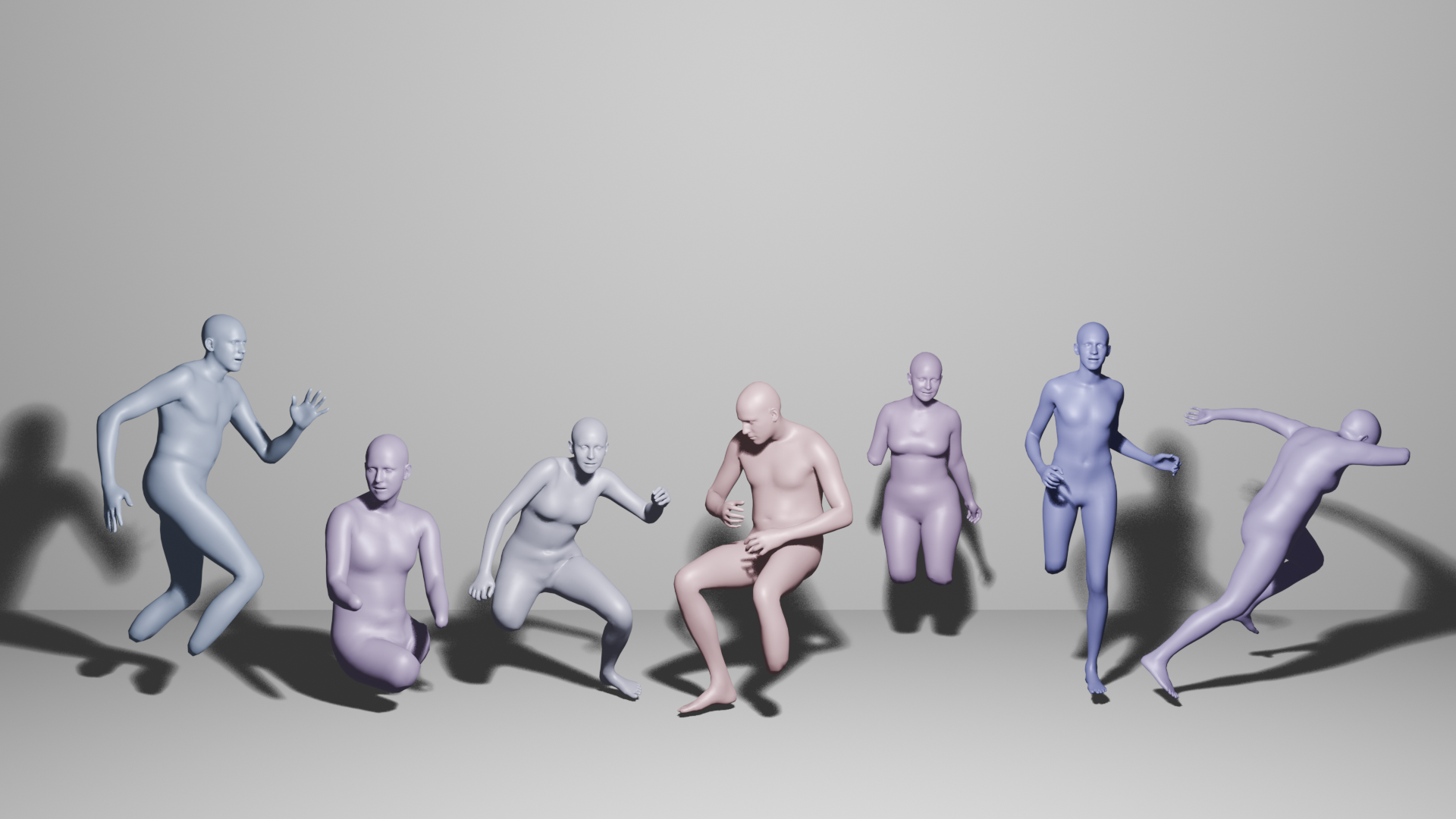
ResiHMR adapts single-image human mesh recovery to non-standard limb anatomy by optimizing over the observed kinematic topology and explicitly reconstructing residual-limb termination geometry.
Project video
Introduction to ResiHMR
Abstract
ResiHMR: Residual-Limb Aware Single-Image 3D Human Mesh Recovery for Individuals with Limb Loss
Existing HMR pipelines inherit intact-limb body priors and often hallucinate missing distal segments. ResiHMR keeps the compactness of parametric mesh recovery while adapting it to observed residual-limb anatomy.
ResiHMR introduces a residual-limb aware framework for recovering anatomically coherent 3D human meshes from a single RGB image. It uses residual-limb keypoints to constrain the optimization to valid kinematic subgraphs and then reconstructs explicit limb-termination surfaces instead of collapsing or masking the missing anatomy.
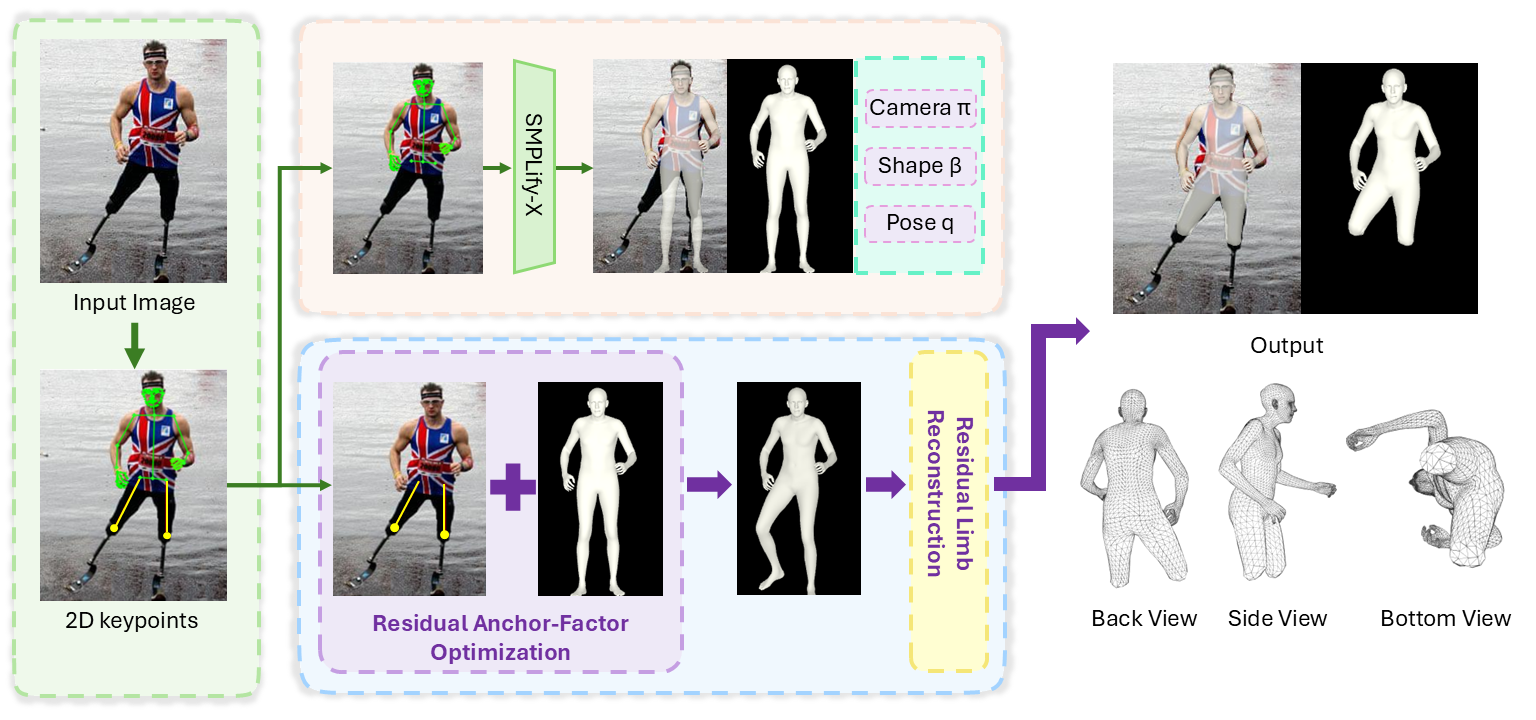
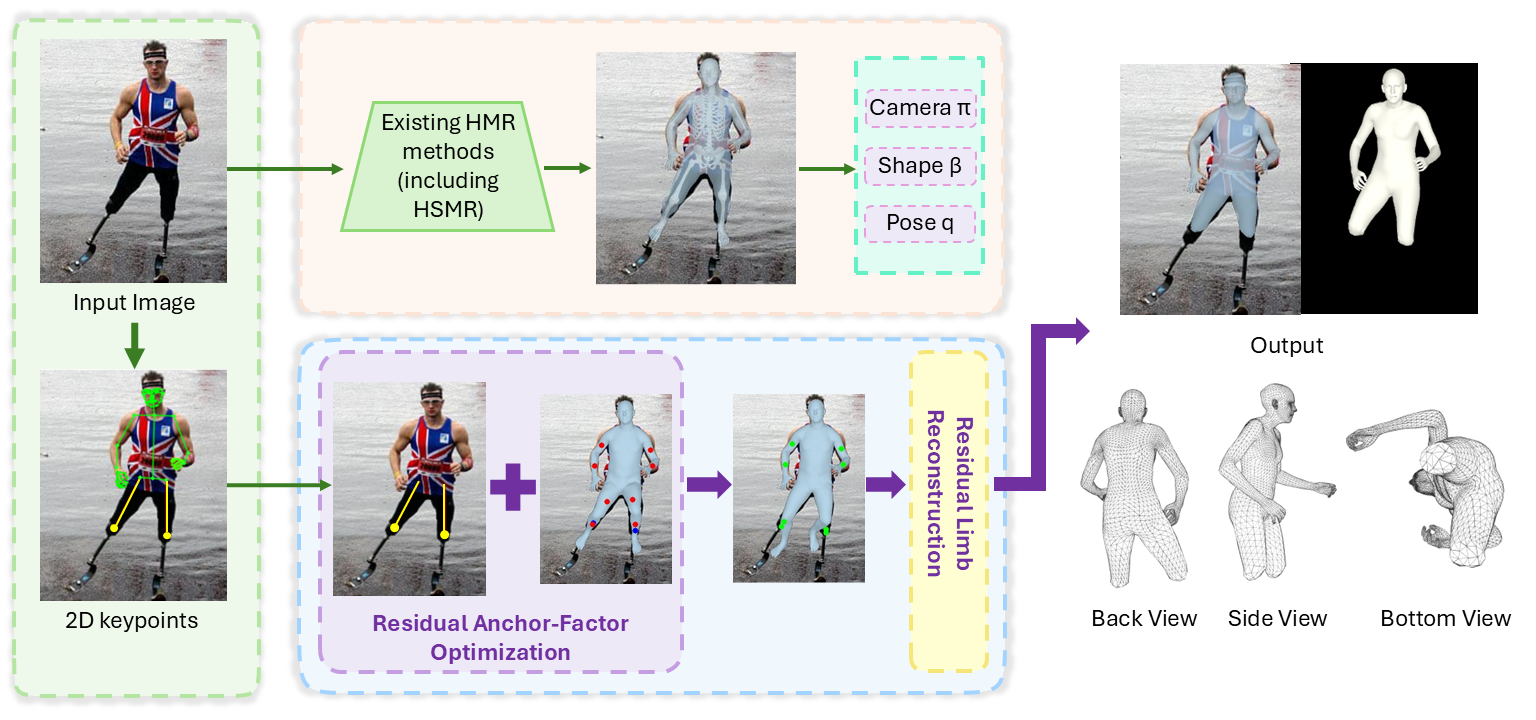
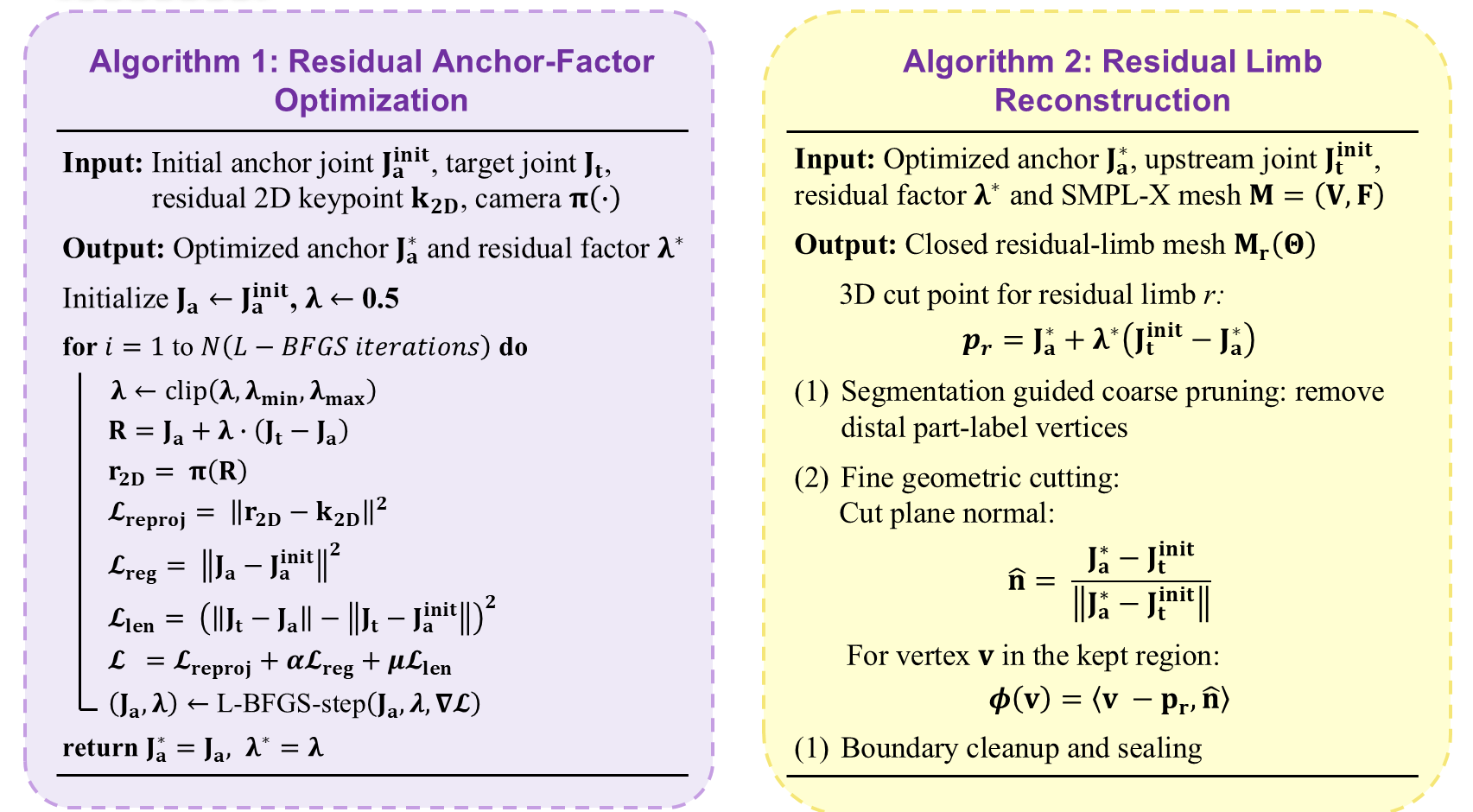
- Residual Anchor-Factor Optimization refines body pose, camera, shape, and residual-limb proportions while respecting limb-loss topology.
- Residual-Limb Reconstruction removes distal geometry and generates a smooth, closed stump surface around the optimized residual endpoint.
- The method is compatible with optimization and regression HMR backbones, including SMPLify-X and HSMR.
Method
Overview of our ResiHMR Framework
ResiHMR is compatible with any HMR pipeline that outputs SMPL-X parameters (camera, pose, and shape), including both optimization-based and regression-based methods.
Evaluation dataset
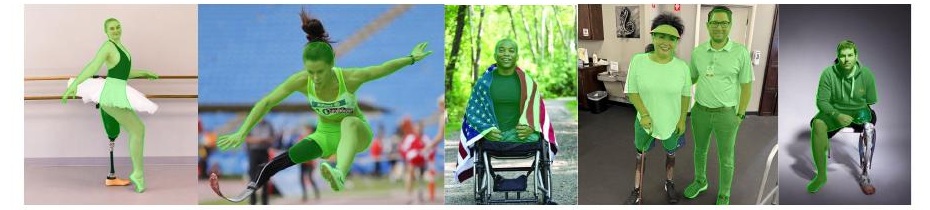
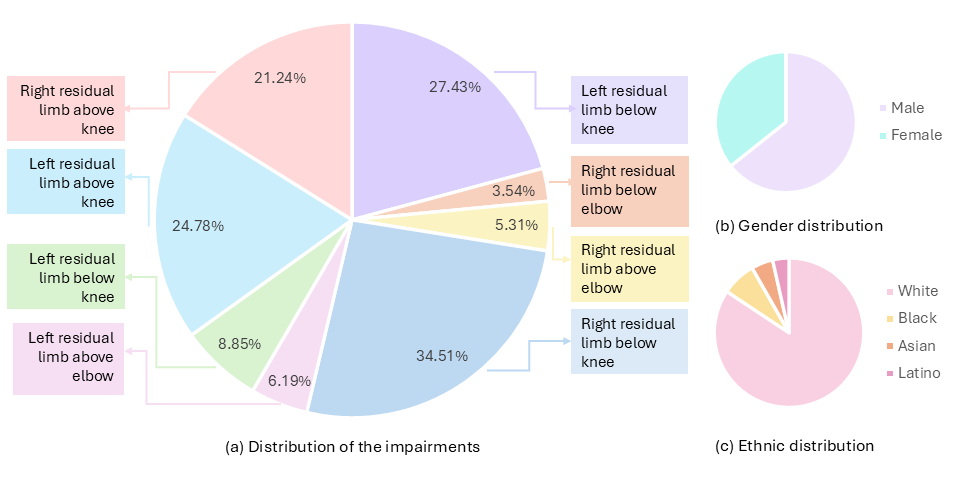
LDPose-LimbLoss Evaluation Dataset
The evaluation set is a curated subset of LDPose with added body masks for silhouette evaluation. It covers upper- and lower-limb loss, diverse activities, occlusions, prosthetic devices, and real-world backgrounds.
Each image includes 2D annotations of 17 standard body keypoints, 8 residual-limb endpoints, and per-person segmentation masks used to isolate the human body region for mesh evaluation.
QuantitativeResults
Comparison of recent HMR methods and ResiHMR
ResiHMR is evaluated with 2D reprojection error for body and residual-limb keypoints, plus mask IoU for silhouette consistency.
| Method | Body Kpts MPJPE ↓ | Res-Limb MPJPE ↓ | Intact Kpts MPJPE ↓ | mIoU ↑ |
|---|---|---|---|---|
| TokenHMR | 34.79 | 102.34 | 31.73 | 0.717 |
| CameraHMR | 29.26 | 78.13 | 25.56 | 0.752 |
| HSMR | 28.27 | 73.61 | 24.56 | 0.705 |
| SMPLify-X | 47.67 | 129.59 | 41.32 | 0.662 |
| ResiHMR (SMPLify-X) | 41.77 | 98.36 | 37.40 | 0.703 |
| ResiHMR (HSMR) | 24.75 | 23.19 | 24.87 | 0.741 |
Numbers are reported on the LDPose-LimbLoss Evaluation Dataset. Lower MPJPE is better; higher mIoU is better. For all other HMR methods, as they do not explicitly predict residual-limb endpoints, we define a naive mid-point proxy on the corresponding limb segment to enable consistent scoring under a unified protocol.
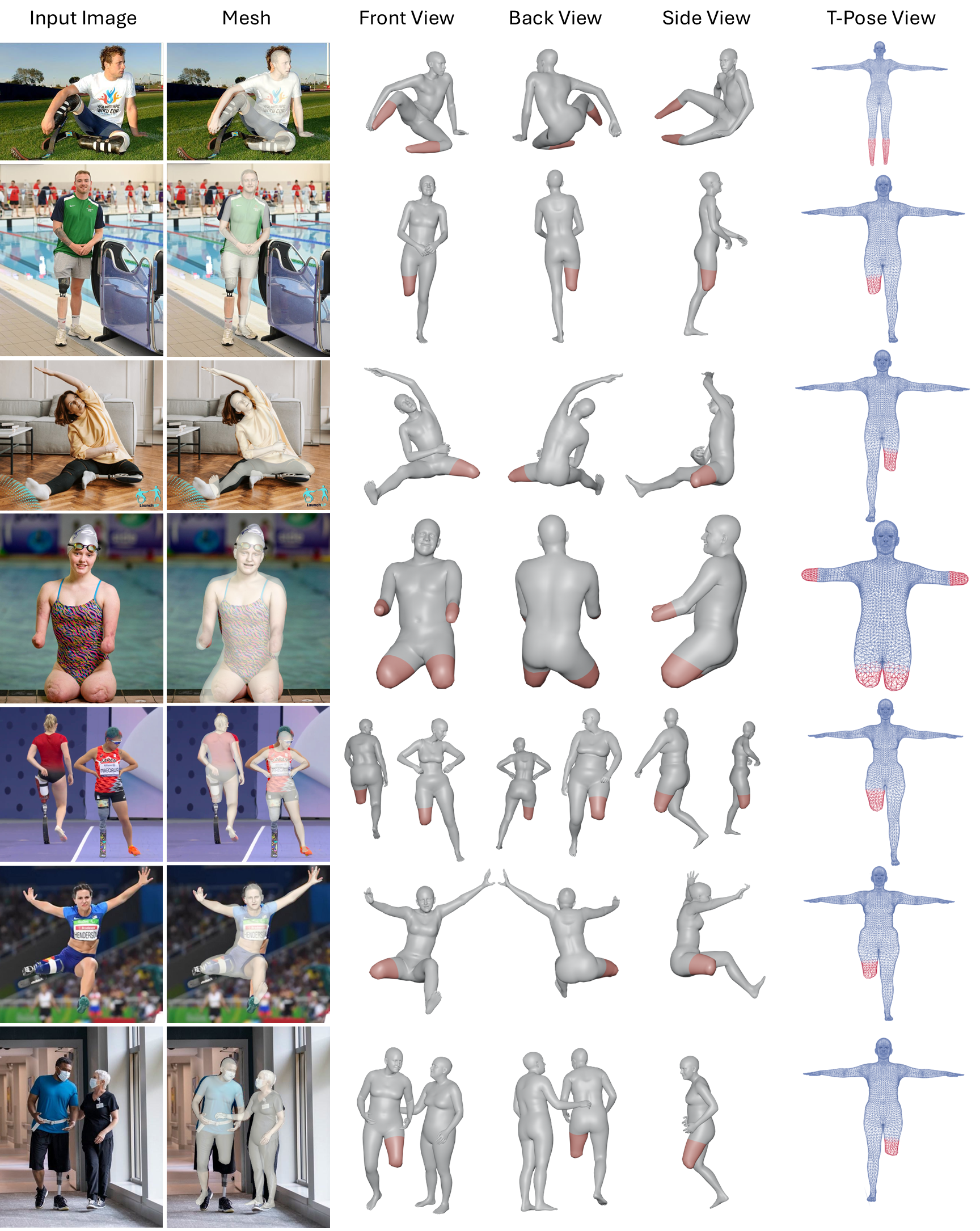
Qualitative results
Qualitative Evaluation of ResiHMR
Citation
Reference
Citation information can be updated after the final proceedings metadata is available.
@misc{ying2026resihmr,
  title  = {ResiHMR: Residual-Limb Aware Single-Image 3D Human Mesh Recovery for Individuals with Limb Loss},
  author = {Ying, Jiaying and Du, Heming and Zhang, Kaihao and Tweedy, Sean M. and Yu, Xin},
  year   = {2026}
}